Tuesday, 22 May 2012
Chocoflan
Chocoflan or Flan Imposible, is a desert which combines a custard sitting on top of a chocolate cake. The custard is poured over the cake batter, yet somehow during baking the cake ends up on top and the custard underneath. Hence the impossible.
The recipe for both the cake and the flan are simple. There is a straightforward recipe in Fanny Gerson's book, where the proportions I have listed here are from.
The Cake
3/4 Cup sugar
3/4 Cup A.P flour
1/3 Cup cocoa powder
1/2 teaspoon baking powder
salt
1/2 cup of buttermilk
3 tablespoons of vegetable oil
1 egg
1/2 teaspoon of vanilla extract
Combine the dry ingredients together, then whisk the wet ingredients together, finally combine the wet team and the dry team and stir until well mixed.
The Custard
1 (12oz) can of evaporated milk
1 (14oz) can of condensed milk
4 eggs
1/2 teaspoon of vanilla extract
1/2 teaspoon of salt
Blend all of the above in a blender.
Making the Cake
Grease and then pour some cajeta over the bottom of an 8 inch cake pan or a bunt pan (the cake will be cooked in a ban marie so a springform tin won't do).
Pour the cake batter into the pan. Gently pour the custard over the batter without disturbing it. Place the cake pan in a larger dish with hot water that comes half way up the side of the cake pan. Cover with foil and bake at 375F for about 50 minutes.
Allow the cake to cool for a couple of hours before removing from the dish and garnish with some chopped nuts.
It's really bizarre, the custard that you poured so carefully over the batter has somehow sunk to the bottom and the chocolate cake is now on top and there the a perfectly clean line separating them. It looks very unusual and it looks like it takes a lot more trouble than it actually does.
The recipe for both the cake and the flan are simple. There is a straightforward recipe in Fanny Gerson's book, where the proportions I have listed here are from.
The Cake
3/4 Cup sugar
3/4 Cup A.P flour
1/3 Cup cocoa powder
1/2 teaspoon baking powder
salt
1/2 cup of buttermilk
3 tablespoons of vegetable oil
1 egg
1/2 teaspoon of vanilla extract
Combine the dry ingredients together, then whisk the wet ingredients together, finally combine the wet team and the dry team and stir until well mixed.
The Custard
1 (12oz) can of evaporated milk
1 (14oz) can of condensed milk
4 eggs
1/2 teaspoon of vanilla extract
1/2 teaspoon of salt
Blend all of the above in a blender.
Making the Cake
Grease and then pour some cajeta over the bottom of an 8 inch cake pan or a bunt pan (the cake will be cooked in a ban marie so a springform tin won't do).
Pour the cake batter into the pan. Gently pour the custard over the batter without disturbing it. Place the cake pan in a larger dish with hot water that comes half way up the side of the cake pan. Cover with foil and bake at 375F for about 50 minutes.
Allow the cake to cool for a couple of hours before removing from the dish and garnish with some chopped nuts.
It's really bizarre, the custard that you poured so carefully over the batter has somehow sunk to the bottom and the chocolate cake is now on top and there the a perfectly clean line separating them. It looks very unusual and it looks like it takes a lot more trouble than it actually does.
Monday, 14 May 2012
Yet more cook book recommending
I'm getting nervous that I may need to charter a plane to ship home the books I have collected over the past couple of years in Mexico, so this one was selected on the basis that it's small.
It's straightforward without being dumb and well photographed. I'm still digging through it but it has a couple of concepts that are new to me and a few ideas worth trying.
Queso in Salsa
This dish is so simple I feel silly even describing it. There are no new techniques and no new ingredients, but the dish is quick and tasty and is an unusual way to use cheese.
Queso in Salsa comprises a cheese, one of the non melting ones, panela is easiest but queso fresco can be used too. The cheese is served in a tomato sauce, and as these cheeses don't melt the end result looks like cubes (in the case of panela) or blobs (in the case of queso fresco) of tofu suspended in sauce.
The tomato sauce is made as we have seen in lots of other dishes (rajas con queso for example), simply tomatoes, blitzed to a liquid in a blender and then cooked out, with some onion, garlic, chile, oregano and seasoning. Rather than adding the onion to the blender it can be cut into strips and sautéed with the chile until translucent before adding the tomato.
Tinned tomatoes can be substituted for fresh, and personally I prefer not to blend the chile with the tomatoes and I feel it muddies the nice red colour, though I'm probably just being picky.
Once the sauce has cooked out the cubed panela is added and heated through. At some point in the future I'll go into more detail on Mexican cheeses, there quite a bit to discuss. I've actually made queso fresco once or twice using milk and vinegar or milk and lime juice. It's fun to do and in interesting experiment, though I don't think I'll be breaking out the cheese cloth on any regular basis.
The dish can be eaten with tortillas or served like a soup. Easy!
Queso in Salsa comprises a cheese, one of the non melting ones, panela is easiest but queso fresco can be used too. The cheese is served in a tomato sauce, and as these cheeses don't melt the end result looks like cubes (in the case of panela) or blobs (in the case of queso fresco) of tofu suspended in sauce.
The tomato sauce is made as we have seen in lots of other dishes (rajas con queso for example), simply tomatoes, blitzed to a liquid in a blender and then cooked out, with some onion, garlic, chile, oregano and seasoning. Rather than adding the onion to the blender it can be cut into strips and sautéed with the chile until translucent before adding the tomato.
Tinned tomatoes can be substituted for fresh, and personally I prefer not to blend the chile with the tomatoes and I feel it muddies the nice red colour, though I'm probably just being picky.
Once the sauce has cooked out the cubed panela is added and heated through. At some point in the future I'll go into more detail on Mexican cheeses, there quite a bit to discuss. I've actually made queso fresco once or twice using milk and vinegar or milk and lime juice. It's fun to do and in interesting experiment, though I don't think I'll be breaking out the cheese cloth on any regular basis.
The dish can be eaten with tortillas or served like a soup. Easy!
Wednesday, 25 April 2012
Enfrijoladas De Pollo
Enfrijoladas
For some reason enfrijoladas (similar to an enchilada but using a sauce made of beans rather than a salsa) are far classier than you would initially think something so simple should be. Perhaps it the silkiness of the bean sauce or perhaps is the possibilities they offer for dainty presentation - with folded triangles of corn tortilla, resembling crepes, dressed in a light creamy sauce.
They are, despite how fussy or rustic a presentation you prefer, very satisfying.
I enjoy them in rolls, like an enchilada, stuffed with a little chicken and dressed with some Mexican chorizo, a little crema and some queso fresco.
The Bean Sauce
Black beans make the most impressive looking enfrijoladas but any beans can be used, and while I used beans I cooked myself, there is nothing wrong with substituting tinned beans.
The beans need to be blitzed in the blender with enough stock (and some onion and garlic if desired) to make a light sauce. Consistency is critical here, you should be aiming for something close to, or just slightly thicker than, a coating consistency. The sauce thickens quite a bit as it cools. Softening the tortillas in the sauce is a pain if the sauce is too viscous, and the dish is ruined if the sauce is think and lumpy.
There is a good recipe here from Rick Bayless, and while I'm sure cooking some of the chorizo with the beans, as he does, makes for an even more delicious sauce, it's not possible if you are using already cooked beans - as I normally am.
Once the beans have been blitzed with the stock the sauce is strained into a saucepan to heat through.
At this point you will probably find yourself adding liquid to the beans to keep the correct consistency as it will thicken very fast, especially in a wide shallow pan. When it's hot each tortilla is dipped in the liquid to make it pliable before being rolled around a couple of teaspoons worth of shredded chicken and plated. The tortillas have to be softened first. You can either steam them wrapped in a towel or, as I do, microwave them for 30 seconds or so while in a tortilla warmer.
Chorizo
Mexican chorizo is very different to the Spanish version, it is a fresh sausage and is not cured so it requires cooking before use. It's highly spiced, but not particularly hot, and normally sold in sausage-like plastic casings, though it can also be purchased loose resembling a very fine mince.
When cooked it can be used in a number of dishes; papas con chorizo or huevos con chorizo and can also be sprinkled over things like enchiladas or in this case our enfrijoladas.
Assembling Everything
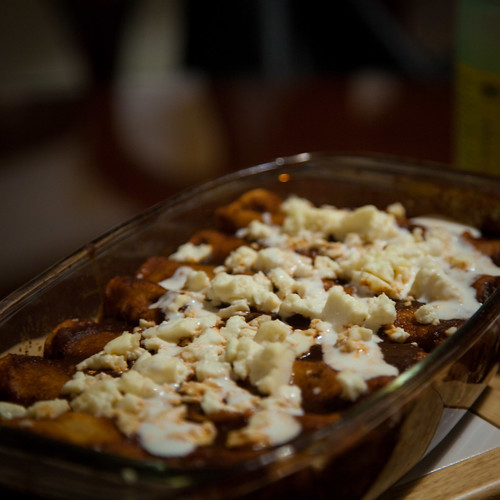
After the tortillas have been softened in the sauce they are rolled around a small amount of shredded chicken, Three or four of these cigars are placed on a plate and covered with the sauce then dressed with the chorizo, crumbled queso fresco and a lick of crema.
You could also do something similar with triangles of tortilla without filling, or for something more rustic just the filled tortillas folded over in half and laid upon each other,
It's hard to find fault with the dish, it's simple, quick to prepare provided everything is to hand, a sauce of black beans looks very striking and if you have been careful to make a smooth creamy sauce it's quite elegant. It makes a perfect weekend breakfast or a quick lunch.
For some reason enfrijoladas (similar to an enchilada but using a sauce made of beans rather than a salsa) are far classier than you would initially think something so simple should be. Perhaps it the silkiness of the bean sauce or perhaps is the possibilities they offer for dainty presentation - with folded triangles of corn tortilla, resembling crepes, dressed in a light creamy sauce.
They are, despite how fussy or rustic a presentation you prefer, very satisfying.
I enjoy them in rolls, like an enchilada, stuffed with a little chicken and dressed with some Mexican chorizo, a little crema and some queso fresco.
The Bean Sauce
Black beans make the most impressive looking enfrijoladas but any beans can be used, and while I used beans I cooked myself, there is nothing wrong with substituting tinned beans.
The beans need to be blitzed in the blender with enough stock (and some onion and garlic if desired) to make a light sauce. Consistency is critical here, you should be aiming for something close to, or just slightly thicker than, a coating consistency. The sauce thickens quite a bit as it cools. Softening the tortillas in the sauce is a pain if the sauce is too viscous, and the dish is ruined if the sauce is think and lumpy.
There is a good recipe here from Rick Bayless, and while I'm sure cooking some of the chorizo with the beans, as he does, makes for an even more delicious sauce, it's not possible if you are using already cooked beans - as I normally am.
Once the beans have been blitzed with the stock the sauce is strained into a saucepan to heat through.
At this point you will probably find yourself adding liquid to the beans to keep the correct consistency as it will thicken very fast, especially in a wide shallow pan. When it's hot each tortilla is dipped in the liquid to make it pliable before being rolled around a couple of teaspoons worth of shredded chicken and plated. The tortillas have to be softened first. You can either steam them wrapped in a towel or, as I do, microwave them for 30 seconds or so while in a tortilla warmer.
Chorizo
Mexican chorizo is very different to the Spanish version, it is a fresh sausage and is not cured so it requires cooking before use. It's highly spiced, but not particularly hot, and normally sold in sausage-like plastic casings, though it can also be purchased loose resembling a very fine mince.
When cooked it can be used in a number of dishes; papas con chorizo or huevos con chorizo and can also be sprinkled over things like enchiladas or in this case our enfrijoladas.
Assembling Everything
After the tortillas have been softened in the sauce they are rolled around a small amount of shredded chicken, Three or four of these cigars are placed on a plate and covered with the sauce then dressed with the chorizo, crumbled queso fresco and a lick of crema.
You could also do something similar with triangles of tortilla without filling, or for something more rustic just the filled tortillas folded over in half and laid upon each other,
It's hard to find fault with the dish, it's simple, quick to prepare provided everything is to hand, a sauce of black beans looks very striking and if you have been careful to make a smooth creamy sauce it's quite elegant. It makes a perfect weekend breakfast or a quick lunch.
Saturday, 24 March 2012
Not Your Mother's Olla Express...
I have picked up a number of cooking prejudices from my mother, one if these is a distrust of pressure cookers and a belief that they are nasty hissing explosive things and too fiddly to be worth bothering with. Lately they are much praised for making stock by people with well thumbed copies of Harold McGee, and every recipe I read for beans cooked in a pressure cooker seems to contain the obligatory remark that today's pressure cookers are not like you remember from your mother's kitchen.
I had been growing tired of leaving beans to soak and of endlessly simmering them. I was in the habit of forgetting the soaking beans and accidentally leaving them ferment, so I decided it was time to challenge my prejudice and buy a pressure cooker so I could cook my beans quickly and without soaking.
I'm converted.
Frijoles de la Olla
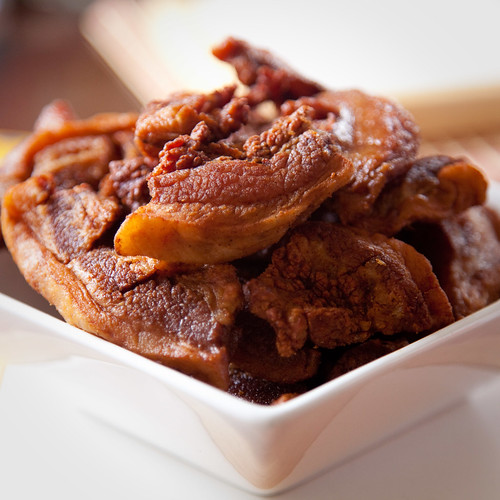
I've covered this before so I'm not going to go through the details of the preparation. In this case I used dry pinto beans, a couple of pieces of onion and celery, a jalapeño and a couple of pieces of the chicharron pictured below.
The beans were cooked for a hour from the time the pot came up to pressure and were perfect. They were soft through but not in danger of falling apart. This will turn cooking beans from a weekend chore to something I can do in an evening without any hassle.
Braised Shin of Beef
The next outing for the pressure cooker was to braise some beef. Much of the meat here used in tacos, for example carne desherbrada or the weekend barbacoa (which is very popular here in Monterrey) is cooked long and slow and cooked down into a very soft texture. I was looking to replicate that texture with a shin of beef.
I cooked two think slices from a shin on beef in a small quantity of water and chicken stock in the pressure cooker along with some onion, a lot of garlic, a couple of chipotle peppers with some adobo and a mixture of cumin, bay leaves, allspice, nutmeg, pepper and clove.
In this case I cooked everything for over two hours and left to cool in the pot. The following day I removed the meat from the liquid and shredded it. I took the couple of cups of liquid, strained it and then reduced it by half. When the liquid was reduced I added it to the shredded meat and cooked the slightly soupy mix together in a wide pan until the liquid had reduced further and I was left with just tender moist meat.
This made some great tacos. The meat was very soft and moist and the highly reduced stick gave it a very meaty taste and the slight gelatinous texture that is reminiscent of barbacoa (though in terms of taste barbacoa is simpler without the Christmas spices in this dish). The tacos were dressed with some onion and corriander and some habenero salsa.
I guess I'm converted to using a pressure cooker. I guess the only remaining prejudice handed down to me is a dislike of condensed milk. I wonder how long that will last?
I had been growing tired of leaving beans to soak and of endlessly simmering them. I was in the habit of forgetting the soaking beans and accidentally leaving them ferment, so I decided it was time to challenge my prejudice and buy a pressure cooker so I could cook my beans quickly and without soaking.
I'm converted.
Frijoles de la Olla
I've covered this before so I'm not going to go through the details of the preparation. In this case I used dry pinto beans, a couple of pieces of onion and celery, a jalapeño and a couple of pieces of the chicharron pictured below.
The beans were cooked for a hour from the time the pot came up to pressure and were perfect. They were soft through but not in danger of falling apart. This will turn cooking beans from a weekend chore to something I can do in an evening without any hassle.
Braised Shin of Beef
The next outing for the pressure cooker was to braise some beef. Much of the meat here used in tacos, for example carne desherbrada or the weekend barbacoa (which is very popular here in Monterrey) is cooked long and slow and cooked down into a very soft texture. I was looking to replicate that texture with a shin of beef.
I cooked two think slices from a shin on beef in a small quantity of water and chicken stock in the pressure cooker along with some onion, a lot of garlic, a couple of chipotle peppers with some adobo and a mixture of cumin, bay leaves, allspice, nutmeg, pepper and clove.
In this case I cooked everything for over two hours and left to cool in the pot. The following day I removed the meat from the liquid and shredded it. I took the couple of cups of liquid, strained it and then reduced it by half. When the liquid was reduced I added it to the shredded meat and cooked the slightly soupy mix together in a wide pan until the liquid had reduced further and I was left with just tender moist meat.
This made some great tacos. The meat was very soft and moist and the highly reduced stick gave it a very meaty taste and the slight gelatinous texture that is reminiscent of barbacoa (though in terms of taste barbacoa is simpler without the Christmas spices in this dish). The tacos were dressed with some onion and corriander and some habenero salsa.
I guess I'm converted to using a pressure cooker. I guess the only remaining prejudice handed down to me is a dislike of condensed milk. I wonder how long that will last?
An Unusual Salad
Something that surprises anyone getting familiar with Mexican cooking is how much they love soy sauce, Worcester sauce (or salsa tipo Inglesa as they call it) and Maggi seasoning.
They feature in drinks like micheladas; a mixture of beer with lime and some combination of the above condiments, sometimes with tomato juice or with clamato (a mixture of tomato juice and clam juice). The drinks are not something I like, but they are a good hangover cure, and I might cover the various types at some point.
Worchester sauce is used on its own as a seasoning for grilled meats, however, more unexpectedly, a combination of the three condiments is used as the basis of a crisp and refreshing salad.
There is a seafood restaurant near where I work where this salad is left in the middle of the table for diners to share.
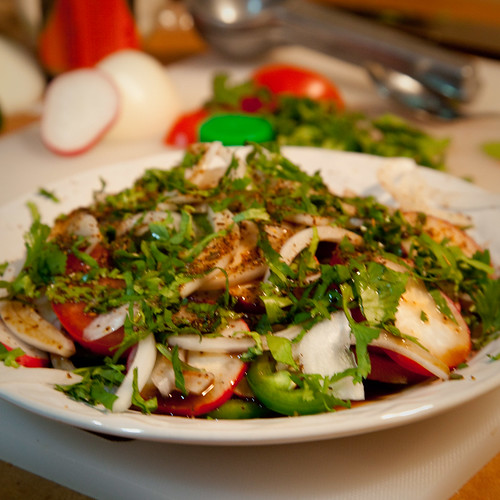
It is comprised rounds of of sliced radish, carrot and jalapeño along with sliced onion and chopped corriander. The salad is dressed (or more accurately sits in a pool of) a dressing comprised of lime juice, soy, Worcester and Maggi. The relative proportions are roughly; a tablespoon of soy, a teaspoon of Worcester and a half teaspoon of Maggi for the juice of each two limes. The objective it a dressing with a balance of sour, salty and savoury.
The salad it then sprinkled with Chile Y Limon which is a type of seasoning salt with chile powder and lime which is often sprinkled on fruit here and is used to dress the rim of a michelada glass in place of salt.
The salad is hot, sour, salty, crunchy and savoury - a list of attributes one would generally associate with Thai rather tan Mexican food, in fact, aside from the absence of fish sauce and possibly some sugar this is something one would not be surprised to see in a Thai cookbook.
They feature in drinks like micheladas; a mixture of beer with lime and some combination of the above condiments, sometimes with tomato juice or with clamato (a mixture of tomato juice and clam juice). The drinks are not something I like, but they are a good hangover cure, and I might cover the various types at some point.
Worchester sauce is used on its own as a seasoning for grilled meats, however, more unexpectedly, a combination of the three condiments is used as the basis of a crisp and refreshing salad.
There is a seafood restaurant near where I work where this salad is left in the middle of the table for diners to share.
It is comprised rounds of of sliced radish, carrot and jalapeño along with sliced onion and chopped corriander. The salad is dressed (or more accurately sits in a pool of) a dressing comprised of lime juice, soy, Worcester and Maggi. The relative proportions are roughly; a tablespoon of soy, a teaspoon of Worcester and a half teaspoon of Maggi for the juice of each two limes. The objective it a dressing with a balance of sour, salty and savoury.
The salad it then sprinkled with Chile Y Limon which is a type of seasoning salt with chile powder and lime which is often sprinkled on fruit here and is used to dress the rim of a michelada glass in place of salt.
The salad is hot, sour, salty, crunchy and savoury - a list of attributes one would generally associate with Thai rather tan Mexican food, in fact, aside from the absence of fish sauce and possibly some sugar this is something one would not be surprised to see in a Thai cookbook.
Wednesday, 29 February 2012
Chintextle Revisited
A few posts ago I discussed chintextle, a paste made using pumpkin seeds and dried chile. I mentioned at the time that there was also a version that used dried shrimp instead of pumpkin seeds.
It sounded strange enough that I decided I should try it. I know this is an odd diversion to take given the hundreds of far more canonical dishes I haven't covered yet, but so what - it's got dried shrimp!
The recipe itself is simple; about a dozen dried shrimp toasted on a lot comal, toasted chile - I used about 8 to 10 chiles cascabel - a clove of garlic, a good splash of vinegar and enough oil to form a paste of it all in the blender.
It tastes exactly like what you imagine a paste made from dried shrimp would taste like. I'm not saying that's a bad thing, it's pretty elemental, you certainly wouldn't eat a lot of it, but there is something about it that keeps bringing you back for another small taste. It's intriguing.
I have absolutely no idea however how it could be used. I think it would be nice stirred into a fish soup but I suspect that's not what it's intended for. Until I think of a use it's winking at me every time I open the fridge, and I take a little pick of it now and again. Though I suspect it'll last a long time so there is no rush in figuring it out.
It sounded strange enough that I decided I should try it. I know this is an odd diversion to take given the hundreds of far more canonical dishes I haven't covered yet, but so what - it's got dried shrimp!
The recipe itself is simple; about a dozen dried shrimp toasted on a lot comal, toasted chile - I used about 8 to 10 chiles cascabel - a clove of garlic, a good splash of vinegar and enough oil to form a paste of it all in the blender.
It tastes exactly like what you imagine a paste made from dried shrimp would taste like. I'm not saying that's a bad thing, it's pretty elemental, you certainly wouldn't eat a lot of it, but there is something about it that keeps bringing you back for another small taste. It's intriguing.
I have absolutely no idea however how it could be used. I think it would be nice stirred into a fish soup but I suspect that's not what it's intended for. Until I think of a use it's winking at me every time I open the fridge, and I take a little pick of it now and again. Though I suspect it'll last a long time so there is no rush in figuring it out.
Migitas
Another very quick and simple breakfast dish. Migitas (or migas which seems to be a more common name, and also means "crumbs" in Spanish) are simply corn tortillas, fried until golden and then scrambled with eggs.
There is not a lot to describe, the tortillas are cut into strips of about a finger's width and a couple of inches long - but there is no need for any precision - when golden brown the eggs are added and everything is scrambled, seasoned and served, either alone as a light breakfast, or in a tortilla.
For the frying butter is nice as is lard, but vegetable oil is grand, and I find two tortillas per three eggs to be the ideal proportions.
Some versions contain onion, tomato and some chile, much as you would if making Machacado, however I prefer the simpler version with nothing but egg and tortilla, and if I were going to do something more complicated I'd rather make machacado or chileaquiles anyway.
One thing I do notice about Mexican egg dishes, especially these breakfast dishes, is that they are not afraid to cook the egg a lot quicker and faster the I would. I'm used to cooking scrambled eggs very slowly and carefully and generally serve them a lot looser than any Mexcican seems comfortable with. "If they are done in the pan then they are overdone in the plate" isn't the motto here. In fact the normal procedure is to fry the tortilla strips, then crack the eggs directly into the pan and mix until roughly scrambled and tightened.
If you are in a hurry Migitas are perfect, they can be cooked and on the plate in seconds, so are a fantastic quick breakfast. They also have some texture, which I like because personally I find eating plain scrambled eggs in the morning more of a chore than a pleasure.
There is not a lot to describe, the tortillas are cut into strips of about a finger's width and a couple of inches long - but there is no need for any precision - when golden brown the eggs are added and everything is scrambled, seasoned and served, either alone as a light breakfast, or in a tortilla.
For the frying butter is nice as is lard, but vegetable oil is grand, and I find two tortillas per three eggs to be the ideal proportions.
Some versions contain onion, tomato and some chile, much as you would if making Machacado, however I prefer the simpler version with nothing but egg and tortilla, and if I were going to do something more complicated I'd rather make machacado or chileaquiles anyway.
One thing I do notice about Mexican egg dishes, especially these breakfast dishes, is that they are not afraid to cook the egg a lot quicker and faster the I would. I'm used to cooking scrambled eggs very slowly and carefully and generally serve them a lot looser than any Mexcican seems comfortable with. "If they are done in the pan then they are overdone in the plate" isn't the motto here. In fact the normal procedure is to fry the tortilla strips, then crack the eggs directly into the pan and mix until roughly scrambled and tightened.
If you are in a hurry Migitas are perfect, they can be cooked and on the plate in seconds, so are a fantastic quick breakfast. They also have some texture, which I like because personally I find eating plain scrambled eggs in the morning more of a chore than a pleasure.
Sunday, 19 February 2012
A couple of different ways with Arrachera
Arrachera is a signature cut of beef in the north of Mexico and especially in Monterrey. The cut is from the underside of the animal, either from the flank or plate. There seems to be no consistency in the definition and you find the cut being indicated as equivalent to hanger steak, which comes from the plate (the animals abdominal muscles near the diaphragm) or as flank steak (again underneath the animal but closer to the hind legs).
What I buy, which is sold as arrachera, is clearly hanger steak. It's a fairly ragged looking cut with a long grain. The restaurants which specialise in arrachera (like here for example) seem to use the thicker flank steak cut.
The steak, when served, is cut perpendicular to the long fibres to make it more tender. The meat has a much more intense taste than steaks from the relatively under worked muscles on the top of the animal. Though the common advice is to serve the meat rare to keep it tender, I don't agree, given the fibrous nature of the cut, unlike a regular steak it is actually more tender when well cooked.
I invested in a new grill an used the opportunity of it's first use to compare three different methods of preparing arrachera. For cooking I used mesquite charcoal, which is traditional, and gives a long even heat and is not as hot as the charcoal bricks I would be used to using at home. (I'd never go back to those pressed briquettes after working with lump charcoal like this!)
Arrachera in 3 Chile Adobo
The first was a cut of arrachera (which you can see in a previously posted picture) marinaded in a 3 Chile Adobo rub. I have covered adobos already, so I won't go into detail. The rub was made from toasted and soaked guajillo, ancho and cascabel chiles, along with garlic, black pepper, allspice, cinnamon clove cumin and salt.
The meat was slathered in the paste and left to marinade for a couple of hours before cooking
Arrachera Marinaded in Pickled Jalapeño and Tequila
This was something I picked up from the internet and you see lots of versions under the same theme. In this case the meat is marinaded using the contents of a can of pickled jalapeños and a slosh of tequila.
The meat, jalapeños, can liquor and the tequila were all dumped into a large zip-lock bag and stashed in the fridge until cooling time. Unlike the adobo the marinade has a lot of acid which should help to tenderise the meat.
Simple Arrachera
The third, and simplest, approach was simply to season the meat with plenty of salt and dried Mexican oregano.I guess this was the control in the experiment.
Guess what!
Simple is best.
By far.
What I buy, which is sold as arrachera, is clearly hanger steak. It's a fairly ragged looking cut with a long grain. The restaurants which specialise in arrachera (like here for example) seem to use the thicker flank steak cut.
The steak, when served, is cut perpendicular to the long fibres to make it more tender. The meat has a much more intense taste than steaks from the relatively under worked muscles on the top of the animal. Though the common advice is to serve the meat rare to keep it tender, I don't agree, given the fibrous nature of the cut, unlike a regular steak it is actually more tender when well cooked.
I invested in a new grill an used the opportunity of it's first use to compare three different methods of preparing arrachera. For cooking I used mesquite charcoal, which is traditional, and gives a long even heat and is not as hot as the charcoal bricks I would be used to using at home. (I'd never go back to those pressed briquettes after working with lump charcoal like this!)
Arrachera in 3 Chile Adobo
The first was a cut of arrachera (which you can see in a previously posted picture) marinaded in a 3 Chile Adobo rub. I have covered adobos already, so I won't go into detail. The rub was made from toasted and soaked guajillo, ancho and cascabel chiles, along with garlic, black pepper, allspice, cinnamon clove cumin and salt.
The meat was slathered in the paste and left to marinade for a couple of hours before cooking
Arrachera Marinaded in Pickled Jalapeño and Tequila
This was something I picked up from the internet and you see lots of versions under the same theme. In this case the meat is marinaded using the contents of a can of pickled jalapeños and a slosh of tequila.
The meat, jalapeños, can liquor and the tequila were all dumped into a large zip-lock bag and stashed in the fridge until cooling time. Unlike the adobo the marinade has a lot of acid which should help to tenderise the meat.
Simple Arrachera
The third, and simplest, approach was simply to season the meat with plenty of salt and dried Mexican oregano.I guess this was the control in the experiment.
Guess what!
Simple is best.
By far.
Tuesday, 13 December 2011
Subscribe to:
Posts (Atom)